
Every VC has a thesis. The problem is that most databases were not built to understand one.
You know what you are looking for: vertical SaaS serving a regulated industry, climate infrastructure with recurring revenue, or B2B marketplaces with embedded fintech. But when you open PitchBook, Grata, or Harmonic, you are still configuring SIC codes, toggling revenue bands, and manually reading company descriptions to figure out if a business actually matches your criteria.
This comparison cuts through that. Below is a direct evaluation of four platforms: AlphaLens, PitchBook, Grata, and Harmonic, across the criteria that matter most for thesis-driven company search: search quality, data depth, workflow integration, and who each tool actually suits.
The core problem with traditional database search
The deal sourcing category has a long tail of legacy products built around static taxonomies: SIC codes, NAICS codes, and pre-defined sector tags. Those structures were designed for public markets and regulatory filings, not for finding a company whose product strategy matches your exact investment logic.
The result is a workflow most VC professionals know well. You pull a list of 800 companies from a database, spend a week manually reading websites, cut it to 60 relevant targets, then repeat the process every quarter as new companies emerge. According to Coresignal's analysis of deal sourcing workflows, manual research and company discovery remains one of the most time-consuming stages of origination. AI-native platforms are beginning to close that gap, but not all of them solve the thesis-matching problem at source.
Platform-by-platform breakdown
1. AlphaLens - best for thesis-native search
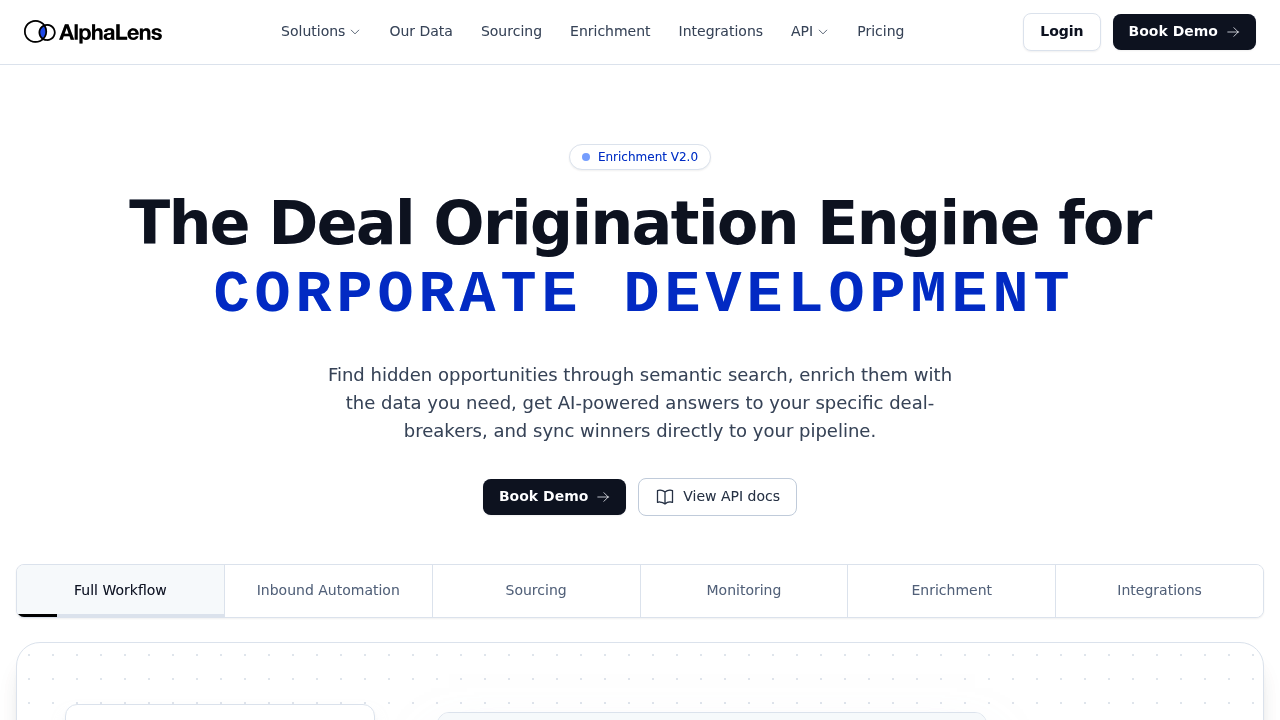
AlphaLens is built specifically around the idea that investors should be able to describe their target profile in plain language and get back a precise, monitored pipeline, not a list of 4,000 vaguely relevant companies.
The search engine is semantic rather than keyword-based. Instead of forcing you into industry tags, it reads across product descriptions, company manifestos, ICP definitions, and service pages to understand what a business actually does. You can type something like "embedded compliance software for financial advisers" and the platform understands the intent behind that query rather than just matching those exact words.
Beyond discovery, AlphaLens turns saved searches into live monitoring alerts, so a thesis you define once continues surfacing new matches automatically. The enrichment layer is substantial: firmographic data, headcount growth time-series, website traffic trends, job posting signals, funding history, and product-level intelligence covering target audience, tech stack, and use cases. Qualified matches can be pushed directly into Salesforce, HubSpot, Affinity, or Attio via native CRM integrations.
The platform also handles inbound screening. Pitch decks in PDF, PPTX, DocSend, Google Slides, Notion, or Pitch.com formats are ingested automatically, with OCR extraction and AI-powered question answering against deal-breaker criteria.
Strengths: True semantic search across product-level data, automated thesis monitoring, deep enrichment, native CRM sync, and document ingestion for inbound flow.
Weaknesses: Less suited to teams who need historical fund performance benchmarking or LP-level data. Coverage is global but intentionally weighted toward thesis depth over raw company count.
Best for: VC and corporate development teams running thesis-based origination who want discovery, enrichment, screening, and CRM sync in a single workflow.
2. PitchBook - best for institutional data depth
PitchBook is the institutional standard for private market data. It tracks a broad universe of companies, investments, deal activity, cap tables, fund performance, and LP commitments. For deep diligence research and benchmarking comparable transactions, it is hard to match.
Search, however, is still largely filter-based. You navigate sector taxonomies, revenue ranges, geography, and deal stage. That works well for structured queries but struggles when your thesis does not map cleanly to a recognized industry category. An emerging vertical like "AI-native fleet management" will not have a clean PitchBook taxonomy entry.
Pricing is enterprise-grade, which is appropriate for large funds with multiple team members needing comprehensive data access, but harder to justify for a lean origination team.
Strengths: Unmatched financial data depth, cap table and LP data, historical deal coverage, and strong institutional trust.
Weaknesses: Taxonomy-dependent search limits thesis-driven discovery. High cost. Used by many competitors, so proprietary edge is limited.
Best for: Institutional PE and VC funds needing comprehensive data for due diligence, benchmarking, and structured screening by financial criteria.
3. Grata - best for middle-market private company discovery
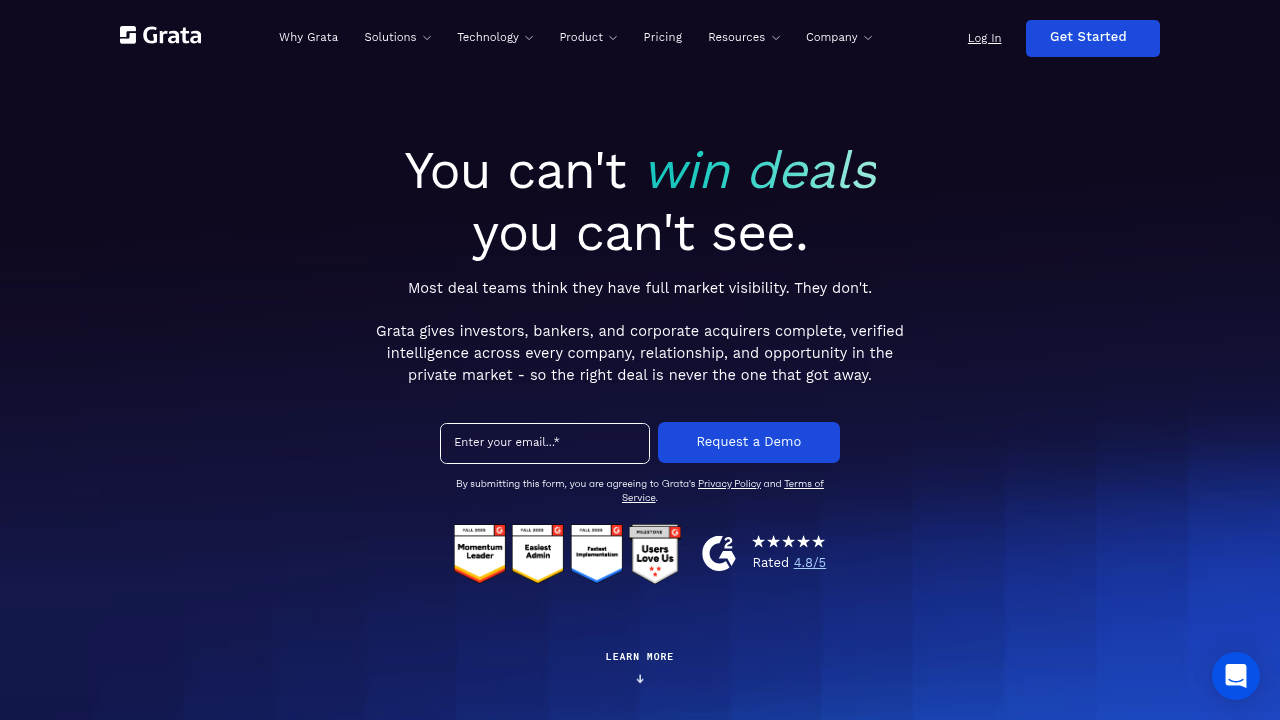
Grata, acquired by Datasite in June 2025, specializes in the US middle market: founder-owned, bootstrapped businesses that do not appear in VC-focused databases. Its AI-driven Deep Search crawls company websites to go beyond static tags, and it covers a large private-company universe.
For PE firms and M&A advisers sourcing lower-middle-market targets, Grata delivers genuine value: web-based business model classification, event and conference roster tracking through SourceScrub, now part of the same Datasite parent, and a direct outreach workflow. The Datasite consolidation means tighter integration with M&A execution tools may be coming, though the transition introduces some pricing and schema uncertainty.
Grata's primary limitation for thesis-driven VC work is that its coverage is heavily US-centric, and its company profile data does not go as deep on product intelligence: tech stack, target audience, and use-case-level signals. That matters when you are screening for product-market fit rather than revenue size.
Strengths: Strong US middle-market coverage, AI web search, event tracking, and good fit for direct outreach to founder-owned businesses.
Weaknesses: US-centric, limited product-level intelligence, and some consolidation uncertainty after the Datasite acquisition.
Best for: PE and M&A teams sourcing proprietary deal flow in the US lower and middle market.
4. Harmonic - best for early-stage signal detection
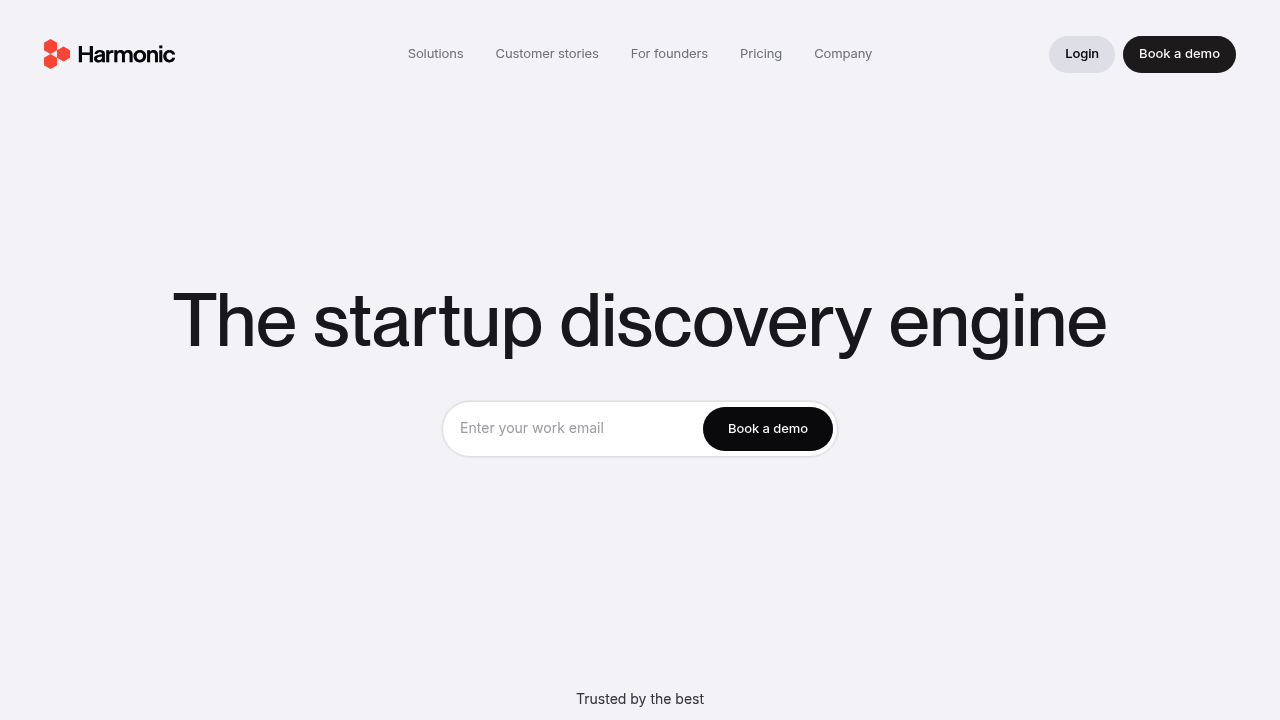
Harmonic is built for investors who want to find startups before they appear on mainstream databases. It tracks companies and individual profiles, and monitors real-time signals such as hiring velocity, incorporation filings, website traffic, and LinkedIn growth to surface companies at the earliest detectable stage.
In May 2025, Sifted reported that Inven, a Harmonic competitor, raised a Series A, a clear signal that early-stage AI discovery has meaningful investor appetite. Harmonic itself is a strong product in this niche, particularly for seed and Series A investors who prioritize getting to a founder first.
The limitation is workflow depth. Harmonic excels at surfacing signals but does not offer the same thesis-aware search, document ingestion, enrichment pipeline, or native CRM sync that deal teams need once they want to move from scouting to screening and pipeline management.
Strengths: Real-time signal monitoring, broad company and people coverage, and excellent fit for early-stage discovery.
Weaknesses: Thinner workflow integration, limited product-level intelligence, and search that is signal-driven rather than thesis-driven.
Best for: Seed and early Series A investors who want to identify high-growth startups before they announce funding rounds.
Side-by-side comparison
| Criterion | AlphaLens | PitchBook | Grata | Harmonic |
|---|---|---|---|---|
| Search type | Semantic / thesis-native | Filter / taxonomy-based | AI web search | Signal-based |
| Product-level intelligence | Yes | Limited | Limited | Minimal |
| Global coverage | Yes | Yes | US-focused | Yes |
| Real-time monitoring | Yes, saved search alerts | Limited | Event-based | Yes, hiring signals |
| Document ingestion | Yes, including PDF, PPTX, DocSend, and more | No | No | No |
| CRM sync | Salesforce, HubSpot, Affinity, Attio | Limited | Limited | Limited |
| Funding/growth data | Yes | Extensive | Moderate | Moderate |
| Cap table / LP data | No | Extensive | No | No |
| Best stage | All stages | Growth / buyout | Lower-middle-market / buyout | Seed / Series A |
| Pricing model | B2B SaaS subscription | Enterprise | Moderate | Moderate |
Which platform suits which team?
You are a VC running thesis-driven origination: you have a clear investment logic and need to find companies that match it, monitor the market continuously, and push qualified targets into your CRM without manual data entry. AlphaLens is built for this exact workflow.
You are at an institutional fund that needs deep financial data for diligence: cap tables, fund benchmarks, LP commitments, and historical deal comps. PitchBook is the right anchor, though you will likely still need a separate sourcing tool to actually find proprietary opportunities.
You are a PE or M&A team focused on the US middle market: sourcing founder-owned businesses, targeting conference attendees, and running direct outreach campaigns. Grata, despite the post-acquisition uncertainty, remains strong here.
You are a seed investor who wants to identify companies before they raise: you need hiring signals and incorporation data more than enriched company profiles. Harmonic is your best option for early detection, though you will need to manage the subsequent workflow elsewhere.
For most VC professionals running a small team across multiple theses or geographies, the real issue is not a lack of data. It is the absence of a platform that understands what you are looking for rather than making you translate your thesis into someone else's taxonomy. That is the gap AlphaLens was specifically designed to close.